
Myofascial Release
Release Tightness That Runs in Lines. Restore Your Movement.
Some tightness is bigger than one sore spot. Myofascial release is for the larger regions and lines of tightness that don't respond to other muscle work — where whole groups of muscles and nerves are trapped under adhered connective tissue.

As Seen On









Overview
Your Muscles Are Wrapped
in Connective Tissue.
Fascia is the layered band of fibrous tissue that wraps and surrounds every muscle, bone and organ. Inflammation, trauma, repetitive stress and postural imbalances create adhesions and restrictions — snags — in it, and groups of muscles and nerves get trapped underneath.
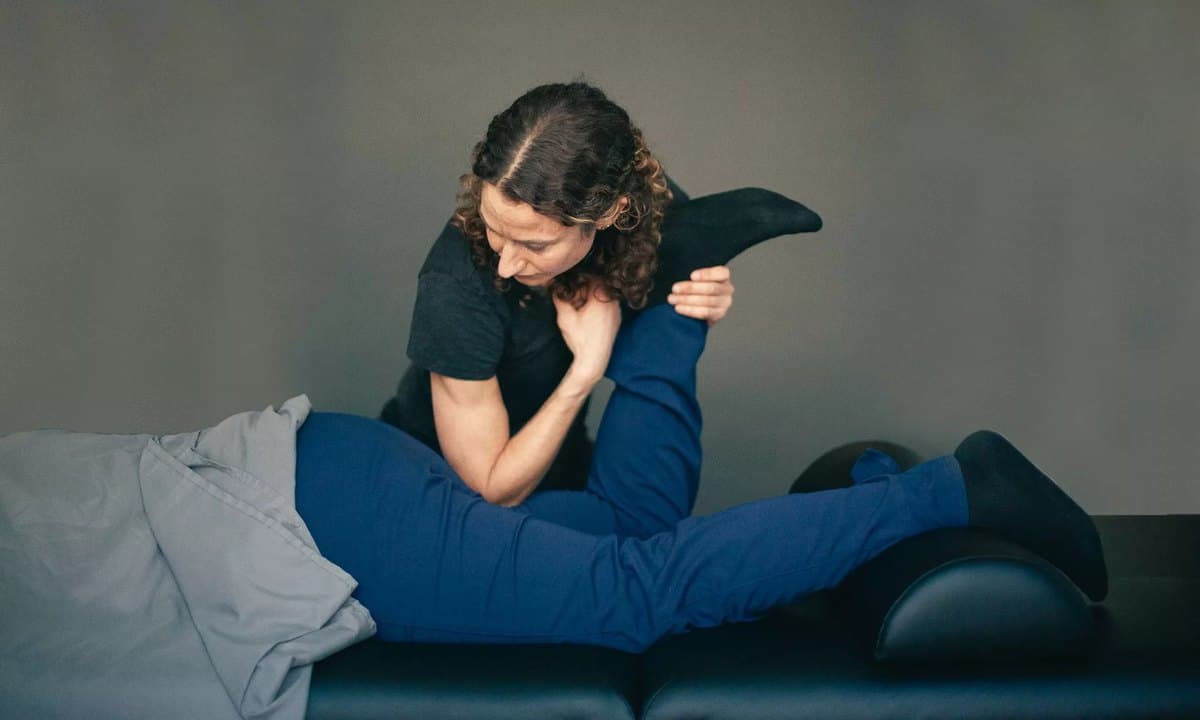
To release a snag, your therapist stretches or bends the fascia slowly in a focused area until a change in the tissue is felt. The goal is to warm up irregular fibrotic tissue, then iron it out so it sits more aligned and moves more freely.
Commonly Helps With:
- Chronic and acute pain from muscle tension
- Sports injuries and other muscular conditions
- Restricted joint and muscle mobility
- Postural imbalances and spinal tension
- Tightness that hasn't responded to other muscle work

Why Choose This Treatment
Support Your Body's
Natural Movement.
By addressing restrictions in the fascia and surrounding soft tissue, myofascial release can help reduce discomfort, improve flexibility, and restore more balanced movement.
Pain Relief
Helps ease tension and discomfort associated with restricted soft tissue.
Improved Mobility
Supports greater flexibility and range of motion.
Injury Recovery
Complements recovery from muscle and sports-related injuries.
Better Posture
Helps address muscular tension that may contribute to postural imbalance.
Muscle Balance
Encourages more balanced movement across connected muscle groups.
Stress Relief
Provides a calming, hands-on approach that can help reduce physical tension.


Sports & Medical Massage
Hands-On Recovery
 Licensed Massage Therapist
Amy Montia, PhD, LMT
 Licensed Massage Therapist
Nicole Kabel, LMT
 Licensed Massage Therapist
Stephen Donnelly, LMT
 Licensed Massage Therapist
Atsuhiko Kawamura, LMT
 Licensed Massage Therapist
Lauren Ng
 Licensed Massage Therapist
Elijah Jihaad Dixon

Featured Testimonials
Trusted by Professionals.
Chosen by Patients.
“They take a true team approach.”
“After suffering for a few months I got myself to Physio Logic and found trust in the entire team. They take a true team approach and I feel respected and so well cared for — and I feel so much better!”
Sherry C.
Google review
“They took the time to find the root of my problem.”
“I highly recommend Physio Logic! They took the time to find the root of my problem, and their work has given me a lot of relief. They came up with a great plan for me to address the issue in a limited amount of time. I finally feel like moving again!”
Sharon C.
Google review
“I always felt heard, respected, and encouraged.”
“Dealing with a serious back injury was a rough time for me. I always felt heard, respected, and encouraged during the whole process. Their functional approach is above and beyond any care I’ve received in the past.”
Robert D.
Google review

 View All Reviews
Questions Answered
Everything You
Need to Know.
What is myofascial release?
Myofascial release is a hands-on therapy that uses focused pressure, stretching, and controlled movement to address restrictions and tension in the fascia and surrounding soft tissues.
What is fascia?
Fascia refers to the layered bands of fibrous connective tissue that wrap and surround all muscles, bones and organs. Inflammation, trauma, repetitive stress and postural imbalances create adhesions and restrictions — “snags” — in fascia.
What happens during a myofascial release session?
During a myofascial release session, a therapist uses different manipulation techniques to apply pressure and stretch specific areas of the body. These techniques may include sustained pressure, sliding movements, and gentle stretching. The goal is to release tension and restrictions in the fascia, which helps reduce pain, improve circulation, and restore muscle balance.
Is myofascial release painful?
Myofascial release is a safe and effective treatment that involves applying gentle sustained pressure into the myofascial connective tissue restrictions to alleviate pain and restore range of motion. Throughout the process you are encouraged to give feedback on the sensations and changes you experience in your body, so your therapist can adjust and adapt the techniques used.
Explore More
Explore More Ways to
Move & Recover.



Sports & Medical Massage
Expert Care.
One Connected Team.
Book a session with a licensed massage therapist in Downtown Brooklyn — and if the tightness turns out to be a job for physical therapy or chiropractic, the clinician who needs to see you is already down the hall.