

TMJ Physical Therapy: Evaluation and Exercises
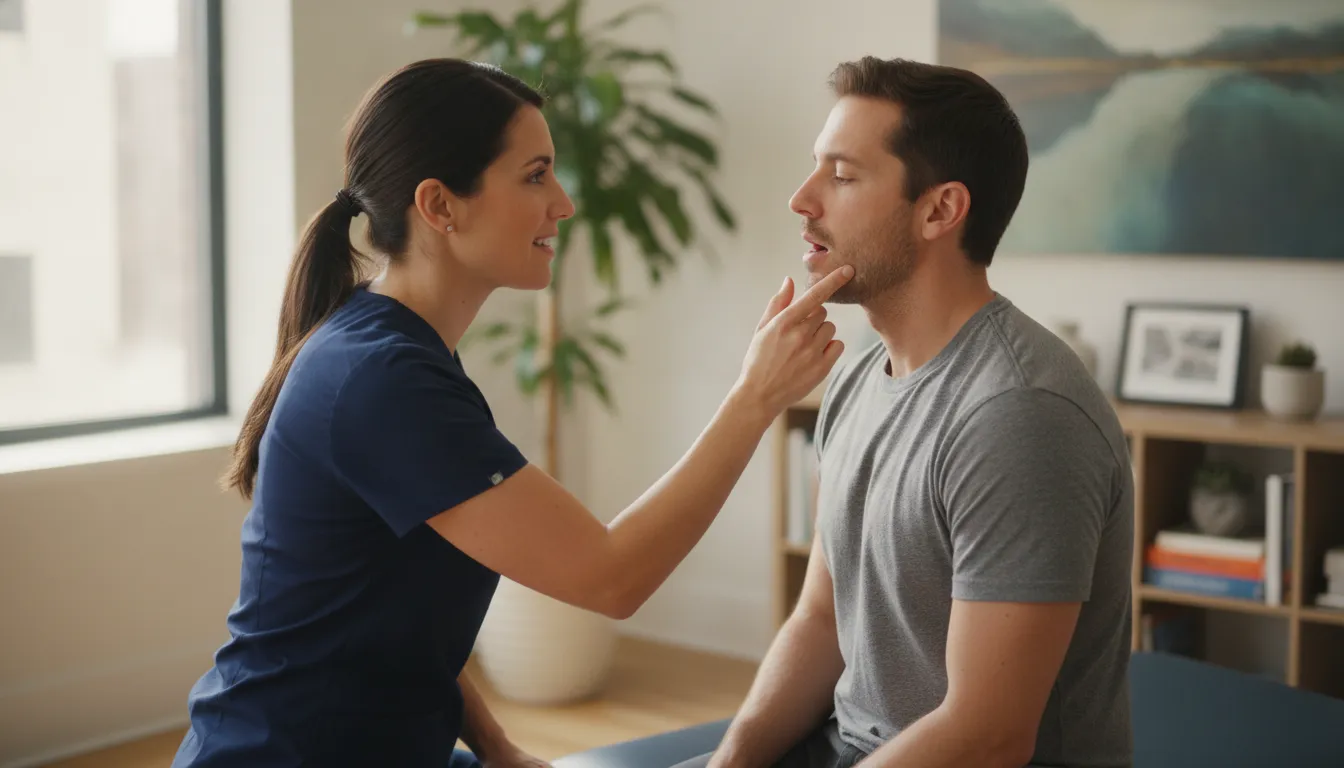
Jaw pain that shows up while you chew, talk, or yawn is often a movement problem, not only a joint problem. TMJ physical therapy starts with a one-on-one evaluation of how your jaw opens, how the muscles around it work, and whether your neck or posture is adding load. A licensed physical therapist uses those findings to decide which exercises, if any, belong in your plan.
At physical therapy in Downtown Brooklyn, you work one-on-one with a New York State licensed Doctor of Physical Therapy. The examination is built around your injury, your goals, and how you move. Nothing in this guide replaces that visit, and no exercise here is a prescription for every jaw.
The National Institute of Dental and Craniofacial Research describes temporomandibular disorders, or TMDs, as more than 30 conditions. They can cause pain and trouble using the jaw joint and the muscles that move it. TMJ names the joint. TMD names the disorder. Many cases are short-lived. Some become long-lasting, and some travel with headaches, neck pain, or sleep trouble. NIDCR's overview of TMD is the public source for those limits.
What a TMJ Physical Therapy Evaluation Checks
A useful visit does not start with a stretch. It starts with a history and a movement exam that tries to match your symptoms to a pattern. The therapist wants to know what you cannot do, what makes it worse, and what has already been tried.
History before hands-on testing
Expect questions about when the pain started, whether it followed dental work, a blow to the face, or a long period of clenching, and which side hurts. Chewing tough food, wide yawning, singing, or long meetings can all change the picture. So can headaches, ear symptoms, neck stiffness, and sleep.
Tell the therapist about locks, a sudden change in how your teeth meet, ringing in the ears, dizziness, or pain that spreads into the face. NIDCR lists those as symptoms that may signal a TMD, while painless clicking is common and often needs no treatment. That distinction matters. A noise by itself is not a plan.
Jaw opening, side glide, and muscle tenderness
The exam then looks at movement you can see. A therapist may measure how far you can open, whether the jaw drifts to one side, and how far you can glide left, right, and forward. Pain at the end of a small movement is different from pain only at a wide opening.
Palpation of the chewing muscles and the joint, just in front of the ear, helps separate muscle tenderness from joint irritation. Both can exist together. NIDCR groups TMDs into joint disorders, including disc problems, chewing-muscle disorders, and headaches tied to a TMD. A person can have more than one at the same time, so one tender spot does not name the whole problem.
Neck, posture, and the tasks you care about
Jaw muscles do not work in isolation. Forward head posture, a stiff upper neck, and long hours at a screen can change how the jaw rests. A therapist may check neck motion and how your symptoms change when you sit tall versus when you crane toward a laptop. The goal is not perfect posture. It is to see whether neck position changes jaw pain or opening.
The visit should also test the task you want back. That might be chewing a meal, opening wide enough for dental care, speaking through a workday, or playing an instrument. What a physical therapy evaluation in Brooklyn includes covers the broader first-visit pattern. A jaw exam uses that same logic on a smaller joint.
If neck pain is the main problem and the jaw is only a side note, a different guide fits better. Neck pain physical therapy in Brooklyn walks through that visit. This article stays on the jaw exam.
What Findings Change the Plan
Two people can both say "my jaw hurts" and leave with different plans. The finding, not the label, decides the next step. The table below is a teaching map, not a diagnosis.
| What the exam finds | What it may suggest | How a PT plan often starts | What it does not prove |
|---|---|---|---|
| Tender chewing muscles. Pain with clenching. Opening that is limited but smooth. | A muscle-dominant pattern. Stress or long static postures may contribute. | Gentle coordination work. Rest from hard chewing. A check of neck position. | It does not prove that a night guard, injection, or adjustment is required. |
| Painful click or grating. Catching. A jaw that locks open or closed. | A joint or disc pattern that needs a closer look. | Stay in a pain-free range. Refer promptly if locking or a bite change is new. | It does not prove that stretching harder will put the disc back. |
| Jaw pain plus neck stiffness. Headache that changes with head position. | Shared load between the jaw and the neck. | Jaw control plus neck mobility. Keep the headache history in view. | It does not prove that every headache is a jaw problem, or the reverse. |
| Pain after trauma. Neurologic changes, fever, or swelling. | A problem outside routine muscle or joint irritation. | Stop exercise trials. Seek medical or dental care first. | It does not prove that physical therapy is the right first stop. |
NIDCR's treatment summary puts the simplest care first and more invasive care last. Jaw exercise and self-management sit in the simple tier. Physical therapy, including manual therapy, sits in the next tier and usually follows a referral from a doctor or dentist. That ladder is why a Brooklyn plan should change when the exam changes, instead of jumping to a joint procedure. The NIDCR summary of TMD treatments is the public source for that order.
Headaches deserve their own caution. Jaw pain and headache can travel together, but a chiropractic article about migraines is a different question. If you are comparing hands-on options rather than learning the exam, read TMJ physical therapy or chiropractic care. This page does not replay that choice.
TMJ Physical Therapy Exercises, Chosen After the Exam
NIDCR lists simple steps to try before more invasive care. Those include jaw stretching and strengthening, soft foods, and heat or cold. Short-term over-the-counter anti-inflammatory medicine may fit when it is appropriate, along with self-management. Physical therapy, including manual therapy, sits in the next tier. A doctor or dentist is usually involved first. Exercises are part of both tiers. They are not a dare to force the joint.
NIDCR lists jaw stretching and strengthening as an early step, not a fixed dose. No public consensus says how many repeats fit every jaw. That is why your therapist should give written cues and change the plan if pain spikes. A drill that was comfortable in the clinic can still be too much at home.
Controlled opening, not a hard stretch
A common starting drill is slow opening on a path you can control. You keep the tongue lightly up, or a mirror in front of you, and stop before a click becomes painful or the jaw veers off line. The point is a smooth, smaller opening you can repeat, not a personal record.
If opening is already painful at a few fingers' width, this drill waits. Forcing range through a lock or a sharp catch can irritate a disc. Your therapist should name the stop point in words you can use at home.
Side glide and a gentle close
Side-to-side glides and a slow close against very light resistance can wake up muscles that have been guarding. Resistance might be a fingertip on the chin, not a hand pushing the jaw. Pain during the glide is a reason to shrink the motion, not to add force.
Isometric holds, where the jaw presses lightly into your hand without moving, are sometimes used when motion itself is irritable. They are a coordination tool. They are not a contest of strength, and they should not recreate your chewing pain.
Neck position as part of the jaw plan
If the exam shows that a forward head position narrows your opening or stirs a headache, the plan may add a simple neck reset. Sit back in the chair, lengthen the back of the neck, and let the jaw hang heavy for a few breaths before you practice opening. This is practice for the hours you spend at a desk, not a posture grade.
Easy walking can support general recovery, but it is not a jaw treatment by itself. If a walk flares your jaw or head, tell your therapist. The dose is part of the treatment, and more is not always better.
- Practice only the motions your therapist cleared, and stop at the first sharp pain or new catch.
- Use a mirror for opening so the jaw stays on a straight path.
- Keep early sessions short. A few slow repeats beat a long painful set.
- Soften your food for a few days if chewing is the flare, as NIDCR suggests.
- Write down what changed: opening, chewing, headache, or sleep. Bring that note to the next visit.
- Skip self-treatment after trauma, a locked jaw, or a new change in your bite until you are examined.
What Physical Therapy Can and Cannot Address
TMJ physical therapy can assess movement, teach control, ease muscle guarding, and help you return to chewing, speaking, and daily tasks when the driver is musculoskeletal. It can also spot when the jaw and neck are sharing a load, and when a plan should stay small.
It cannot diagnose every cause of face pain. NIDCR is clear that there is no single widely accepted test that sorts all TMDs, and that the cause is often unclear. Research does not support the idea that a bad bite or braces are the usual cause. A night guard, dental work, or medication may still be part of someone else's plan. Those decisions belong to a dentist or physician.
Physical therapy also cannot "fix" a joint that needs urgent care. Locking that does not release, pain after a blow to the jaw, swelling, fever, trouble swallowing, or weakness and numbness in the face are reasons to get medical or dental help first. Do not use this article's drills while you wait.
More invasive options exist, and they are not this clinic's physical therapy service. NIDCR groups prolotherapy, arthrocentesis, and arthroscopy as moderately complex. Open surgery is a last resort that deserves a second opinion. The institute also says evidence is not conclusive that botulinum toxin injections into chewing muscles help TMD. Grinding teeth down, or moving them to treat TMD, can make things worse. A physical therapist should not sell those paths.
Physio Logic does not offer dry needling or acupuncture, and this article is not a workers' compensation physical therapy guide. If you want to know how jaw care can sit beside chiropractic care when the exam supports it, use the comparison article linked above. Headache-focused chiropractic care is covered separately in the Brooklyn headache and migraine guide. Do not treat that page as a jaw exercise plan.
Payment is a separate conversation. The practice is moving toward more self-pay care. Do not assume a visit is or is not covered until the clinic confirms your benefits. Payment options explain how to ask.
What to Expect at a Brooklyn Visit
Plan on a one-on-one session. You should leave knowing what was tested, what was irritable, and which one or two drills to try before the next visit. A stack of exercises on day one is a warning sign. So is any promise that a certain number of visits will erase the click.
Bring a short list: medicines, dental work in the last year, and the task you most want back. If headaches or neck pain travel with the jaw, say which one limits you more. That single detail often changes the first plan.
Between visits, keep the home work inside the range that stayed comfortable in the clinic. Heat or a cool pack on the face, softer foods, and a break from gum or wide yawning are the self-care steps NIDCR places first. If pain climbs, opening shrinks, or the jaw locks, stop and call. Do not add reps to push through it.
Care at Physio Logic is built as one clinic, not a single technique. A physical therapist may loop in another provider when the exam shows a reason. That is a clinical decision, not an upsell, and it still starts with the jaw and neck findings above.
Frequently Asked Questions
What happens at a TMJ physical therapy evaluation?
The therapist asks how the pain started and which tasks hurt, then measures opening and side movement, checks muscle tenderness, and looks at neck position. The visit ends with a small plan tied to those findings, not a generic stretch sheet.
Which exercises are used in TMJ physical therapy?
Common examples are slow, straight opening, small side glides, and light holds that do not move the jaw. The right set depends on whether the exam points to muscle guarding, a painful joint, or a neck contribution. Painful clicking or locking is a reason to limit motion, not to stretch harder.
Can TMJ physical therapy help jaw pain?
It can help some people reduce pain and improve opening, especially when the program matches the exam. NIDCR notes that many TMDs are brief, and published reviews do not support one exercise dose for every patient. No clinic can promise that your click or pain will disappear.
Can I do TMJ exercises at home before I am evaluated?
Gentle self-care such as softer foods and heat or cold is reasonable for mild, recent soreness. Skip jaw stretches if you have locking, pain after an injury, a new change in your bite, or symptoms that are getting worse. Those need an exam first.
When is jaw pain not a physical therapy problem?
Seek medical or dental care first for a locked jaw, trauma, swelling, fever, trouble swallowing, face weakness, or numbness. Physical therapy does not replace that evaluation, and it does not include joint injections or surgery.
Talk With a Physical Therapist About Your Jaw
If chewing, opening, or a related headache is getting in the way, a one-on-one exam is the useful next step. Bring the movement that bothers you. The therapist can tell you whether a jaw plan, a neck plan, or a referral fits what they find.
Request a call from the Downtown Brooklyn clinic at 409 Fulton Street, or call (718) 260-1000.