

Piriformis Syndrome vs. Sciatica: How to Tell the Difference
Piriformis syndrome vs sciatica is not always an either-or question. Sciatica describes pain that travels along the sciatic nerve, while piriformis syndrome is one possible source of irritation around that nerve in the buttock. A disc problem in the low back can also irritate a nerve root and cause similar symptoms. The location and pattern of pain can offer clues, but a careful examination is needed to tell what may be driving it.
Request an appointment to discuss your symptoms
What does “sciatica” mean?
Sciatica is a common name for pain, tingling, numbness, or weakness that follows the path of the sciatic nerve from the lower back or buttock into the leg. It is a symptom pattern, not a specific diagnosis. The term does not explain by itself where the nerve is irritated or why.
One frequent cause is a lumbar disc problem. A disc can bulge or herniate and irritate a nearby nerve root as it leaves the spine. The resulting pain may travel from the back or buttock down the back or side of the leg, sometimes reaching the foot. But symptoms differ from person to person, and not everyone with disc changes on imaging has pain from them.
Piriformis syndrome refers to symptoms attributed to irritation or compression of the sciatic nerve near the piriformis muscle, a small muscle deep in the buttock. The nerve’s relationship to this muscle varies among people. Research reviews describe piriformis-related problems as one possible explanation for sciatica-like symptoms, not the only explanation (review of piriformis-related sciatic nerve anatomy; StatPearls overview of piriformis syndrome).
How can the symptoms differ?
Neither pain location nor a single symptom can confirm the cause. Still, the circumstances that bring on pain can help guide an evaluation.
Clues that may fit piriformis-related irritation
- Pain or tenderness feels centered deep in one buttock.
- Sitting for a long time, especially with pressure on the buttock, aggravates symptoms.
- Hip positions that stretch or contract the buttock muscles, such as crossing the legs or turning the thigh inward, may reproduce discomfort.
- Pain may travel into the back of the thigh. Symptoms below the knee can occur, too, so that pattern alone does not rule it out.
- Low-back movement may not consistently change the symptoms, although this is not a reliable rule.
Clues that may fit disc-related sciatica
- Back pain and leg pain occur together, or the leg pain changes with certain back movements, bending, coughing, or straining.
- Pain follows a path from the back or buttock down the leg, sometimes below the knee and toward the foot.
- Tingling, numbness, or weakness accompanies the pain. A clinician may find changes in sensation, strength, or reflexes that fit a nerve-root pattern.
- Symptoms may be influenced by spinal positions or by tasks that load the lower back.
These are patterns, not a home diagnostic checklist. Disc-related nerve irritation can present without prominent back pain, and buttock-focused pain does not prove that the piriformis is responsible. Hip, sacroiliac, and other nerve or soft-tissue conditions can also overlap. A clinician considers the whole history and examination rather than matching one symptom to one label.
What details should you track before an evaluation?
A short symptom record can make the history more useful without turning it into a self-diagnosis. Note where the discomfort starts and where it travels, whether it reaches below the knee, and whether you notice tingling, numbness, or a change in strength. Record when it began and whether it has been steady, intermittent, or changing. If you are unsure whether a sensation is weakness or pain-limited movement, describe what happened rather than trying to name it.
Include a few real examples of activities that change the symptoms. For instance, note whether leg pain increases after sitting through a commute, eases after standing, or changes when you bend to pick something up. Record how long it takes for symptoms to settle after an activity and whether the same response happens more than once. These details can help a clinician compare how the back, hip position, and pressure on the buttock relate to your symptoms.
Keep the record simple. There is no need to provoke pain repeatedly to test a theory. If a certain movement causes sharp, spreading, or worsening symptoms, stop that test and note what occurred. Bring relevant medical history, medication information, and any previous imaging reports if you have them, but do not assume that an image explains the current symptoms before it is reviewed in context.
What can an examination tell you?
An assessment usually starts with a conversation about when symptoms began, where they travel, what makes them better or worse, and whether there has been numbness or weakness. The clinician may ask about recent activity, sitting tolerance, sleep, and changes in everyday tasks. This history helps narrow the possibilities before any single movement test is interpreted.
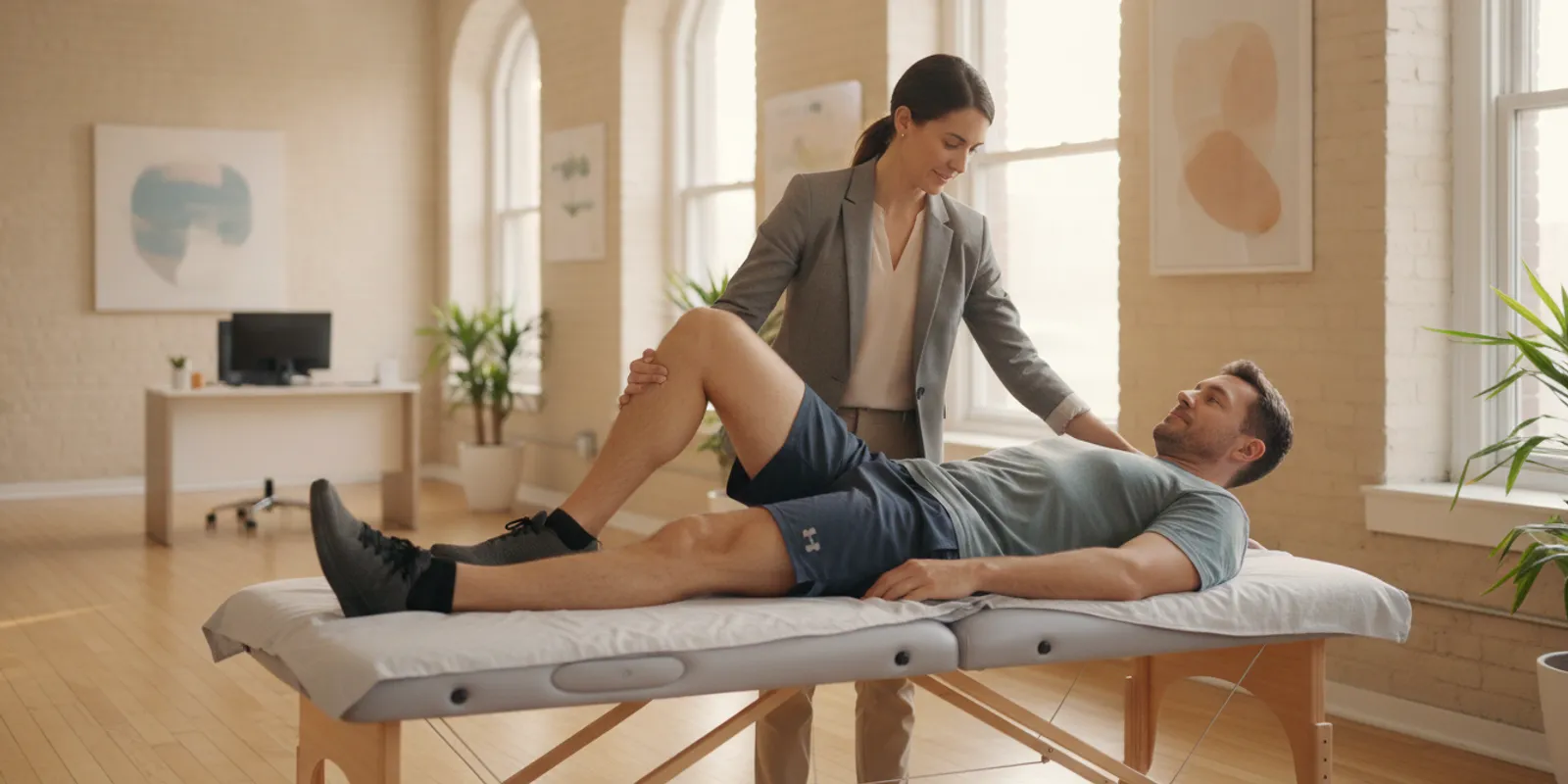
The physical examination may include observation of posture and walking, testing back and hip movement, and checking leg strength, sensation, and reflexes. A clinician may use a straight-leg raise or related nerve-tension test to see whether a position reproduces familiar symptoms. The result is one piece of the picture; it cannot identify a disc as the cause on its own.
These checks answer different questions. A nerve-tension maneuver looks at how symptoms respond when the nerve pathway is placed under gentle tension. Strength and sensation checks look for changes that may suggest which nerve roots are involved. Hip movement tests explore whether a particular position brings on buttock pain. No result should be read in isolation: a painful movement can be sensitive for several reasons, while a normal test does not always explain persistent symptoms.
A useful exam also considers function. The clinician may ask what happens when you sit, stand, walk, bend, or change position, and whether symptoms settle when you stop. Comparing these responses can help distinguish a pattern linked more closely to back movement from one linked more closely to hip position or pressure on the buttock. It also gives a practical baseline for checking whether a plan is helping over time.
To assess possible piriformis involvement, a clinician may position the hip in ways that stretch or contract the deep buttock muscles. If this reproduces the patient's familiar pain, it can support the working hypothesis. It is not proof: nearby muscles and joints may also be sensitive, and test results need to be interpreted alongside the rest of the exam.
The meaning of a test depends partly on whether it reproduces the familiar complaint, not simply whether a movement feels tight or uncomfortable. The clinician may compare sides, change the position slightly, and check whether the result fits the rest of the history. For example, a position that brings on buttock pain is more informative when it matches the person's usual symptoms and other findings also point toward the hip or buttock. Even then, it supports a working explanation rather than confirming one structure as the sole cause.
Imaging is not automatically needed for every episode of leg pain. A clinician may consider it when symptoms, examination findings, duration, or warning signs make further evaluation appropriate. Imaging findings also need context: a scan alone does not establish that a visible disc change is causing a person's symptoms. The plan should respond to the person's clinical picture, not just a picture of the spine.
How do the possible causes compare?
| Feature | Piriformis-related irritation | Disc-related sciatica |
|---|---|---|
| Where the suspected irritation is | Around the sciatic nerve in the deep buttock | Near a spinal nerve root in the lower back |
| Common symptom clues | Buttock-centered discomfort; sitting or certain hip positions may aggravate it | Leg pain may change with back positions or movements; tingling, numbness, or weakness may occur |
| What an exam may assess | Hip movement and positions that load or stretch the buttock muscles | Back movement, nerve-tension response, strength, sensation, and reflexes |
| What helps shape the plan | Findings about hip and buttock function, activity tolerance, and symptom triggers | Findings about the back, nerve function, symptoms, and response to movement |
| Important limitation | No one muscle test confirms the diagnosis | A scan or one nerve test cannot explain symptoms by itself |
The table shows why the difference matters: the same complaint—pain traveling down a leg—can begin in different places. The clinician's goal is to test the most plausible explanations and choose a plan that can be adjusted as the response becomes clearer.
Learn about physical therapy options
Why can the treatment plan differ?
Care should address the suspected source and the tasks that have become difficult. A clinician may begin with steps that are appropriate for the person's symptoms and examination, then reassess. There is no single stretch, exercise, or hands-on technique that is right for everyone with sciatica-like pain.
If the exam points toward the lower back
For disc-related symptoms, a plan may focus on comfortable movement, gradual return to daily activities, and exercises selected after examining how the back and leg respond. Some people may need temporary changes to tasks that repeatedly aggravate symptoms. A therapist can help adjust activity rather than assuming that complete rest or pushing through pain is the answer. The right starting movements depend on the person's findings.
Leg strength, sensation, and symptom changes matter during follow-up. If symptoms worsen or new weakness appears, the care plan may need to change and further medical evaluation may be appropriate. A physical therapy evaluation can help assess movement and function; see the clinic's physical therapy information for a related service option.
If the exam points toward the hip and buttock
When sitting pressure or certain hip positions appear to provoke symptoms, the plan may address those triggers and the person's hip and buttock movement. That might mean testing a sitting adjustment, modifying an aggravating activity, or gradually building tolerance to movement. A clinician should select exercises based on the examination instead of prescribing aggressive self-stretching based only on a label.
Hands-on care may be considered as one part of an individualized plan, but it should not replace assessment of radiating pain or nerve symptoms. Physio Logic offers myofascial release and trigger point therapy; whether either approach is suitable depends on an individual evaluation. Those options are not a way to confirm piriformis syndrome.
If the cause is not clear at first
Some people have overlapping findings or symptoms that do not fit neatly into one category. In that situation, a useful plan starts with the safest reasonable steps, tracks response, and revisits the working explanation if progress is limited. Care may involve communication with a medical provider when the history or exam suggests that another evaluation is needed. Avoid treating a self-diagnosis as settled just because one stretch feels tight or one movement reproduces pain.
For an overview of the clinic's range of care, visit integrative healthcare services. The page is a starting point, not a recommendation that every service is appropriate for every cause of leg pain.
Follow-up is useful because symptoms can change as activity changes. A brief plan might identify a comfortable way to sit or move for now, select a tolerable activity level, and set a time to review whether those steps helped. If the pain travels farther down the leg, weakness develops, or daily function keeps declining, report that change rather than simply progressing an exercise. If an initial approach does not help, the next step is to revisit the examination and assumptions, not to repeat the same maneuver more forcefully.
When should leg pain be checked promptly?
Arrange an evaluation if buttock or leg pain is persistent, recurring, limiting walking or sleep, or accompanied by tingling or numbness. Seek urgent medical care for severe or rapidly worsening weakness, loss of bladder or bowel control, numbness around the groin or saddle area, or other sudden serious symptoms. These warning signs are not typical reasons to try a home stretch first.
Even without an emergency symptom, a timely assessment can help clarify what movements are safe and whether the back, hip, or another structure needs attention. Bring notes about where the pain travels, what activities change it, and any weakness or sensory changes. This detail can make the examination more useful.
Ask about an evaluation for buttock or leg pain
Frequently Asked Questions
Does piriformis syndrome cause sciatica?
It can cause symptoms that resemble sciatica when the sciatic nerve is irritated near the piriformis in the buttock. But “sciatica” describes a symptom pattern, and a disc or another condition may be responsible. An examination helps distinguish possible causes.
Can piriformis syndrome cause pain below the knee?
It can. Pain extending below the knee does not, by itself, prove that a lumbar disc is the source. The full symptom pattern and findings such as strength, sensation, reflexes, and movement response help guide the assessment.
Can I tell the difference with a stretch?
No. A stretch that reproduces pain may show that a position is sensitive, but it cannot reliably identify the source. Stop a movement that causes sharp or worsening symptoms and seek guidance rather than repeatedly testing it.
Does a disc finding on an MRI mean it is causing my leg pain?
Not necessarily. Imaging needs to be interpreted with symptoms and examination findings. A clinician can explain whether the scan is relevant and whether further evaluation is useful.
What is a sensible next step?
If symptoms are affecting your routine, start with an evaluation rather than guessing based on pain location alone. A clinician can review the pattern, examine your back and hip, and discuss what to do next based on the findings.
Knowing whether the pain may be coming from the lower back, the buttock, or another source is the first step toward a plan that fits your symptoms and goals.