

Pelvic Floor Relaxation Breathing for Runners
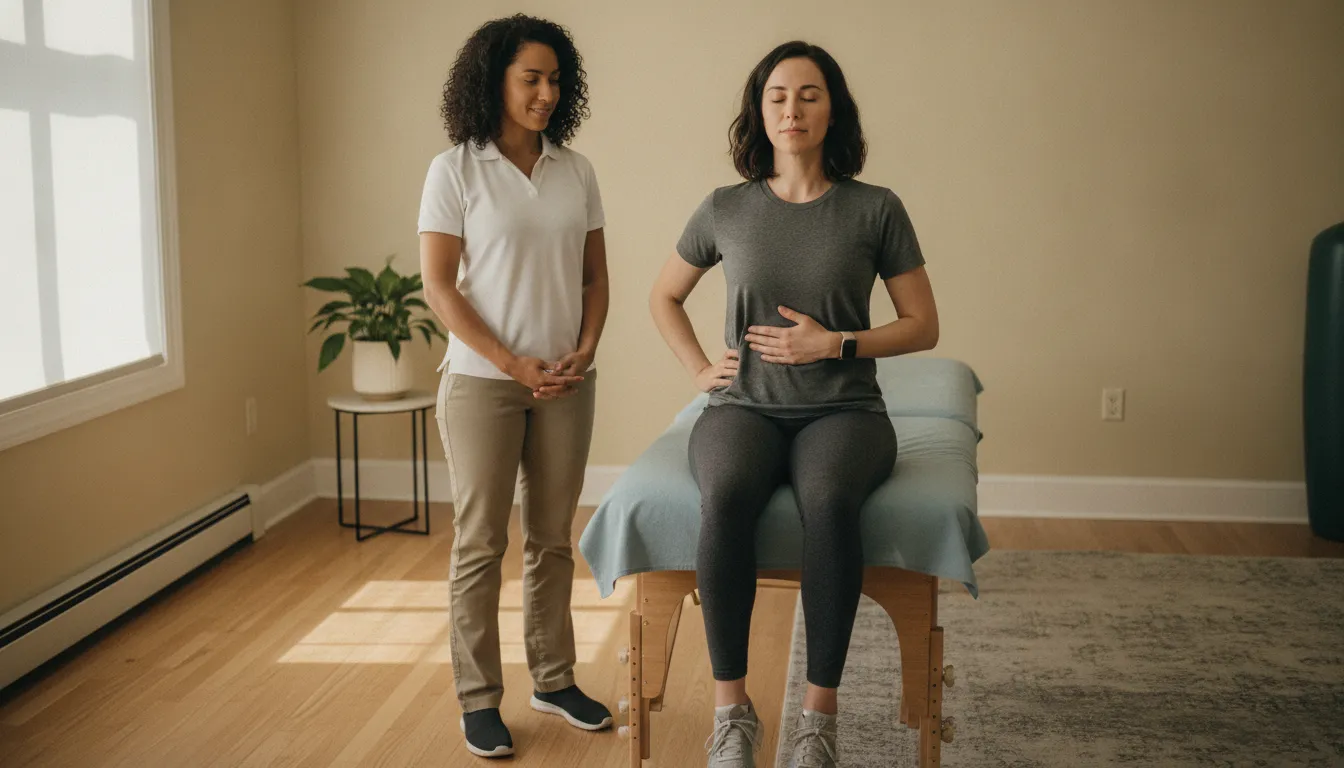
Pelvic floor relaxation breathing for runners is a quiet practice you do off the run, then carry into easy miles as a timing cue. The goal is not a stronger squeeze. It is a fuller inhale, a pelvic floor that can yield, and a way to notice leaking, heaviness, or gripping before you add more miles. A breathing drill does not diagnose pelvic floor dysfunction, and it is not a substitute for an exam when symptoms persist.
Book a pelvic floor evaluation in Downtown Brooklyn
A leak on a downhill is a common reason to look this up. So is a heavy feeling late in a long run. So is a habit of bracing the belly for every step. Those signs can come from coordination, load, breath holding, or something that needs medical care first. This guide covers the practice, the limits, and when a pelvic floor physical therapy visit is the clearer next step.
Why runners ask about pelvic floor relaxation
Running asks the pelvic floor to manage repeated impact. Each landing raises pressure through the abdomen and pelvis. A responsive pelvic floor can yield a little on the inhale and support the organs as the foot hits. A floor that stays gripped, or a breath that stays stuck in the upper chest, has less room to do that job.
People often hear "engage your core" and translate that into a constant hold. A constant hold can be useful for a heavy lift that lasts a few seconds. It is a poor strategy for a 40-minute easy run. The muscles that never get a chance to lengthen also have a harder time producing a timely contraction when you need one on a descent or a surge.
Pelvic floor relaxation breathing for runners is useful in three situations:
- You leak urine with impact, coughing, or the last miles, and you have been told to do more kegels without an assessment.
- You feel heaviness, pressure, or a bulge sensation that eases when you stop.
- You notice you hold your breath on hills, clench the belly, or finish runs with pelvic or tailbone tension.
None of those signs proves a specific diagnosis. They are reasons to change the drill and, if they continue, to get examined. A review of breathing strategies for running notes that purposeful breath work may help tolerance and enjoyment, while estimates of performance benefit are scarce and variable. That paper is a framework, not a pelvic floor protocol. Read it as context, not as a promise that a breathing drill will make you faster: Breath Tools: breathing strategies for human running.
If kneecap pain is the main problem, that is a different question. The return-to-run plan in our runner's knee treatment guide covers loading and kneecap pain. This article stays with breath, pressure, and pelvic symptoms.
What the breath is supposed to do
The diaphragm and the pelvic floor move as a pair. On a quiet inhale, the diaphragm descends and the pelvic floor usually descends a little with it. On the exhale, both rise. If the ribs barely move and the belly stays braced, the pelvic floor often stays high and tight. Relaxation, in this context, means the muscles can let go on the inhale. It does not mean a collapsed posture or a push downward.
Two mistakes show up often in runners:
- Bearing down. A forceful belly push on the inhale increases downward pressure. That is the opposite of a yield. If you feel pressure into the vagina or rectum, or a bulge sensation, stop the drill and get assessed before you practice it again.
- Only squeezing. Kegels train a contraction. They do not teach the release that has to come first if the muscles are already holding. Our comparison of pelvic floor PT and kegel exercises explains why a squeeze program is not always the starting point.
A useful cue is expansion, not effort. The lower ribs widen a little to the sides. The belly softens without popping forward. The pelvic floor feels as if it is getting out of the way, not being pushed out. If you cannot tell the difference, that is a reason to practice with a therapist rather than to add more reps.
Relaxation is not the same as weakness
Some runners need more strength and endurance. Some need a better release. Some need both, in that order. You cannot sort those needs from a blog post. A therapist can test contraction, relaxation, and endurance in positions that look more like running than lying on a table. The live pelvic floor page describes that first visit, including a breathing and core review. And states that an internal exam is used only when it is clinically indicated and you consent. Internal exams are never mandatory.
How to practice pelvic floor relaxation breathing off the run
Practice this when you are not running. Five quiet minutes after a warm shower, or before an easy day, is enough to learn the shape of the breath. Do not add it as a mid-run project on the first day.
- Lie on your back with knees bent, or sit tall on a firm chair. Rest one hand on the lower ribs and one on the belly. Unclench the jaw and the glutes.
- Inhale through the nose for about four seconds. Let the lower ribs widen into your hand. Allow the belly to soften. Do not push it out.
- Pause for one second. Notice whether the pelvic floor feels as if it dropped slightly, or whether you are still holding.
- Exhale through relaxed lips for about six seconds. Let the ribs fall. Do not force a kegel unless a therapist has already taught you a gentle lift at the end of the exhale.
- Repeat for 6 to 8 breaths. Stop if you feel dizzy, if you bear down, or if symptoms increase.
- After a few days, try the same breath sitting, then standing. Standing is closer to the posture you use on the run.
Keep the effort low. If you cannot speak a short sentence after the set, you were working too hard. The drill is a coordination practice, not a workout. If symptoms include tailbone pain at rest rather than a running-breath problem, start with the tailbone article instead of stacking more breathing reps: how pelvic floor therapy approaches tailbone pain.
What to notice while you practice
Write down three things for a week. Did the ribs move, or only the upper chest? Did leaking, urgency, or heaviness change in the hour after practice? Did you bear down? Bring those notes to a visit. They beat a guess about tight or weak.
Pelvic floor relaxation breathing for runners on easy miles
Use a smaller version on easy runs only after the lying and standing practice feels familiar. Easy means you can speak in short sentences. Do not test a new breath strategy in a race, on a steep downhill, or in the last miles of a long run.
A practical pattern for flat, easy running is a light rhythmic breath. Often close to a 3-step inhale and a 2-step exhale, or a 2 and 2 if that matches your cadence better. The point is not a magic ratio. The point is that the inhale still lets the ribs move, and the exhale is not a grunt or a brace. If the count makes you hold your breath to hit the number, drop the count.
On hills and faster efforts, many runners shorten the breath and brace. That can be appropriate for a few seconds of hard effort. It becomes a problem when the brace never turns off. After the hill, take two or three quieter breaths and let the ribs widen before you settle back into the easy rhythm. If leaking or heaviness shows up on the hill, that is information for an evaluation. It is not a cue to push the belly out harder.
| Situation | Breath cue | Stop and get assessed if |
|---|---|---|
| Learning the pattern off the run. | Use a 4-second nose inhale, let the ribs widen, then a 6-second easy exhale. | Stop if you bear down, feel a bulge, or get dizzy. |
| Easy flat running. | Use a light step-timed breath you can keep while speaking short sentences. | Stop if leaking, heaviness, or pelvic pain starts or worsens. |
| Short hill or surge. | A shorter breath is fine for a few seconds. Then return to a quiet inhale. | Get assessed if you cannot release the brace after the effort. |
| Race day or speed work. | Do not introduce a new drill. | Get assessed if symptoms are new, worsening, or include bleeding or bowel leakage. |
Fueling and iron status still matter for how a run feels, but they do not fix pelvic floor coordination. If you are rebuilding mileage and also sorting meals, the runner's diet guide is the place for that question. Keep pelvic symptoms in the pelvic floor visit.
Symptoms that mean the drill is not enough
Stop self-experimenting if any of these show up. Get a medical or pelvic health assessment first:
- Urine or stool leakage that is new, worsening, or happening at rest.
- A bulge, dragging, or heaviness in the pelvis, especially if it is worse after running.
- Pelvic, tailbone, hip, or low-back pain that changes your stride.
- Blood in the urine, bleeding that is not your expected cycle, fever, or pain with urination.
- Numbness, saddle anesthesia, or new bowel or bladder retention. Those need urgent medical care, not a breathing drill.
Postnatal runners have a separate screening standard. The 2019 return-to-running guidance from Grainne Donnelly, Emma Brockwell, and Tom Goom lists clear stop signs. Heaviness, leaking, pelvic or low-back pain, and a noticeable abdominal gap are reasons to contact a pelvic health physiotherapist before you treat running as cleared. It also recommends testing pelvic floor function in lying and in standing, because a table test can miss what happens under impact. A summary of that guidance is here: Return to running postnatal screening points. This article is not a postnatal protocol. If you are returning after birth, use that screen and a visit, not a blog drill, as the gate.
For a broader look at who pelvic floor therapy helps, including incontinence and pressure symptoms, see what pelvic floor physical therapy is. Use that page for the service overview. Use this one for the runner breathing question.
What a Downtown Brooklyn visit looks at
Physio Logic's pelvic floor therapists are New York State-licensed Doctors of Physical Therapy. The department is Pilates-trained and holds advanced postgraduate certification from the Herman and Wallace Pelvic Rehabilitation Institute. The clinic is in Downtown Brooklyn, and the team treats adults of all genders. Athletic overuse is one reason people come in. Postpartum recovery is common, but it is not the only path.
A first visit is an orthopedic and pelvic floor evaluation. It can include muscle tone, movement, posture, breathing pattern, core activation, and, when relevant, scar tissue or joint findings. An internal assessment happens only if it is clinically indicated and you consent. You can decline it and still start care.
For a runner, the useful part of the visit is the translation. A therapist can watch how you breathe in standing, how you land, and whether hip, rib, or pelvic motion is feeding the pressure problem. Chiropractic care and nutrition counseling sit in the same clinic when a plan needs them. A hip or rib restriction may belong with the chiropractic team. Low energy, under-fueling, or a return-to-training question may belong with nutrition. The pelvic floor visit stays the owner of leaking, heaviness, pain, and coordination. You do not need three separate theories before you book the pelvic floor evaluation.
The clinic states that many people notice change within 4 to 6 sessions, and that chronic or complex cases can take longer. That is a clinic range, not a promise for runners. Your timeline depends on findings, mileage, and whether symptoms show up only under impact.
Payment should be checked before you assume coverage. The public payment page says Physio Logic accepts most major insurance, works with in-network and out-of-network benefits, and can verify benefits before you book. It also offers CareCredit for eligible expenses. Verify your own plan. Do not treat a general insurance statement as a guarantee that pelvic floor therapy is covered for you.
Check benefits and book a Downtown Brooklyn visit
How this fits the rest of your training
Breathing practice does not replace strength, shoes, or a sensible mileage build. It changes one input: whether you can release and re-support the pelvic floor while impact repeats. If the drill is easy off the run and symptoms still show up at mile four, the missing piece is usually load tolerance, not more lying-down breaths.
Keep hills and speed work in the plan only if symptoms stay quiet on easy runs. If a downhill consistently causes leaking or heaviness, shorten that workout and bring the pattern to a therapist instead of collecting more data on your own. Core work can help some runners, but a generic core circuit is not a pelvic floor exam. Our note on core exercises for marathon runners is about trunk endurance for long runs. It is not a pelvic floor program, and it should not be used as one if you have leaking or pressure.
If you want the clinic context before you book, the Downtown Brooklyn physical therapy page describes the department around this pelvic floor service. The evaluation itself is the decision point. A blog drill can teach a quieter inhale. It cannot tell you whether you need release work, strength work, a mileage change, or medical care first.
Frequently asked questions
Does running engage the pelvic floor?
Yes. Impact raises pressure through the abdomen and pelvis, so the pelvic floor has to respond on every landing. That does not mean you should squeeze for the whole run. A floor that can relax on the inhale and support on impact is the pattern most runners are trying to find.
What is the 3-2 breathing technique for running?
A 3-2 pattern is three steps on the inhale and two steps on the exhale. Some runners use 2-2 instead. Either can work on easy flats if you can still speak in short sentences and you are not holding the belly. It is a rhythm cue, not a treatment for leaking or heaviness.
How do I fix pelvic floor symptoms fast?
There is no honest fast fix in a breathing drill. If symptoms are new, worsening, or include a bulge, bleeding, or bowel leakage, get assessed before you add reps. A clinic visit can sort release, strength, and load. Many people notice change within a few sessions, and some need longer care.
Should runners do kegels or relaxation breathing?
Start with the question your symptoms ask. If you cannot relax, more kegels can reinforce the hold. If an exam shows poor endurance, strength work may come next. Pelvic floor relaxation breathing for runners is the learning drill, not the whole plan. A therapist should decide the mix.
Can I practice this if I am pregnant or postnatal?
Ask your prenatal or postnatal clinician before you add a new pressure drill. Postnatal return to running has its own screen for heaviness, leaking, pain, and abdominal wall changes. Do not use this article as clearance to run.