

ACL Tear Recovery Physical Therapy Brooklyn

An ACL injury can turn a routine subway stair, weekend run, or competitive season into a difficult question: what will it take to trust this knee again? A well-planned acl tear recovery physical therapy brooklyn program gives you a practical answer. Rather than rushing through a generic timeline, rehabilitation should restore motion, strength, control, confidence, and the specific movements your daily life or sport requires.
Schedule an ACL rehabilitation assessment with Physio Logic NYC.
Recovery is individualized. The right plan depends on whether you had surgery, the type of graft or additional repair, your symptoms, your previous activity level, and your goals. This guide explains the major phases, useful exercises, return-to-sport testing, and the questions to ask when choosing care in Brooklyn. It is educational and cannot replace an evaluation by your surgeon or physical therapist.
ACL Tear Recovery Physical Therapy Brooklyn: The Road Ahead
The anterior cruciate ligament, or ACL, helps control forward movement and rotation of the shin bone relative to the thigh bone. It is especially important during cutting, pivoting, landing, and sudden deceleration. An ACL tear may occur during a noncontact change of direction, an awkward landing, or direct contact. Some people hear or feel a pop, followed by swelling, reduced motion, and a sense that the knee may give way.
Not every ACL tear is managed the same way. Some active adults can pursue nonoperative rehabilitation after consultation with an orthopedic specialist. Others may choose reconstruction because of repeated instability, associated injuries, or a goal of returning to a pivoting sport. Physical therapy can be important in either path. Before surgery, prehabilitation may reduce swelling, restore knee extension, and improve quadriceps strength. After surgery, therapy helps protect healing tissue while progressively rebuilding function.
A common question is how long recovery takes. There is no universal finish date. Return to unrestricted sport after reconstruction often takes many months and may extend beyond nine months, but the calendar is only one part of the decision. Your care team should also consider symptoms, motion, strength, movement quality, sport demands, and psychological readiness. A criterion-based plan advances you when your knee demonstrates the capacity for the next challenge.
What your first assessment should include
A thorough evaluation begins with your history, surgical instructions if applicable, current symptoms, and personal goals. Your physical therapist may assess swelling, knee flexion and extension, walking, quadriceps activation, hip and ankle function, balance, and tolerance for basic tasks. The therapist should also ask what you need to return to, whether that means working on your feet, caring for a child, cycling through Prospect Park, or playing basketball.
At Physio Logic NYC, care can draw on a collaborative team while remaining specific to the patient. Learn more about the clinic's approach to physical therapy and rehabilitation. Coordination with your surgeon is especially important when your procedure included a meniscus repair, cartilage treatment, or another restriction that changes loading or range-of-motion guidelines.
The Main Phases of ACL Rehabilitation
ACL rehabilitation is easier to understand as a sequence of goals rather than a rigid week-by-week recipe. Progress is rarely perfectly linear. Swelling can increase after a new exercise, strength gains can slow, and other health or scheduling factors can affect consistency. Your therapist should adjust the plan based on how your knee responds while keeping the long-term objective in view.
Early phase: protect, calm, and restore motion
Early priorities usually include protecting the knee, managing pain and swelling, restoring full knee extension, gradually improving flexion, and reactivating the quadriceps. When advised by your clinician, the familiar approach is Rest, Ice, Compression, Elevation. It may help manage short-term symptoms, but it does not replace movement and progressive exercise. Medication, brace use, crutches, and weight-bearing limits should follow the instructions of your physician or surgeon.
Full knee extension is particularly important for a normal walking pattern. A therapist may use gentle positioning, patellar mobility, heel slides, quadriceps sets, and gait training as appropriate. The exact exercise dose matters. More is not always better, especially if a session causes swelling or pain that persists. Your therapist can help distinguish expected effort from a warning that the knee needs a modified load.
Middle phase: rebuild strength and single-leg control
Once swelling is controlled, motion is improving, and walking is more comfortable, the program places greater emphasis on strength. Exercises may include supported squats, bridges, step-ups, leg press variations, hamstring work, calf raises, and carefully selected knee-extension work. The selection and range should match your surgical precautions and current capacity.
Single-leg control also becomes increasingly important. Balance drills, split squats, step-downs, and controlled changes in direction can reveal compensations that are easy to miss during two-leg tasks. A patient may feel strong while still shifting weight away from the recovering side. Video feedback, clear cues, and objective measures can help correct that pattern before speed or impact is added.

Progressive strength work should match the knee's current capacity and the patient's goals.
Late phase: power, agility, and return preparation
Later rehabilitation prepares the knee for higher forces and less predictable situations. Depending on your goals, this may include running progressions, jumping and landing, lateral movement, acceleration, deceleration, and sport-specific drills. A recreational runner needs a different progression from a soccer player who must cut under pressure. An active parent or first responder may need lifting, stair, kneeling, or endurance tasks that closely resemble daily demands.
Late-stage work should not be treated as an optional add-on. Strength in a controlled gym exercise does not automatically translate to a safe landing or rapid direction change. Your therapist should increase speed, complexity, fatigue, and unpredictability gradually, then observe whether movement quality remains consistent.
Exercises and Homework That Support Recovery
The most useful ACL exercises are the ones prescribed for your current phase, performed with good technique, and progressed at the right time. A list found online cannot account for graft choice, meniscus restrictions, swelling, pain, or movement compensations. Use the examples below to understand common goals, then ask your physical therapist which exercises are appropriate for you.
Restore motion and quadriceps activation
Early homework may include heel slides for flexion, extension positioning, quadriceps sets, straight-leg raises when they can be completed without lag, and ankle pumps. These drills look simple, but quality matters. For example, a straight-leg raise performed while the knee bends may indicate that the quadriceps is not yet ready for that task. Your therapist can modify the movement or provide another strategy.
Short, consistent homework sessions may be more useful than an occasional long session that irritates the knee. Track swelling, pain, and stiffness after exercise and again the next morning. That information helps your therapist decide whether to maintain, reduce, or progress the dose.
Build strength through the whole movement chain
ACL recovery is not only about the knee. Hip, trunk, calf, and ankle capacity all influence how force moves through the leg. A progressive program may combine squats, hinges, lunges, step-ups, calf raises, hamstring exercises, and trunk control. Some patients may also benefit from Pilates-based physical therapy as one component of a broader plan.
Loading should become meaningfully challenging as healing and symptoms allow. Muscles need sufficient resistance to gain strength, yet the right amount differs by person and phase. Your therapist can monitor technique, compare sides, and adjust exercise selection without making unsupported promises about the speed or outcome of recovery.
Practice landing and change-of-direction skills
Jumping begins with the fundamentals: absorbing force quietly, maintaining control through the hip, knee, and ankle, and avoiding an uncontrolled collapse inward. A progression might move from two-leg landings to single-leg tasks, then add direction, speed, or reaction. Change-of-direction drills should also teach braking mechanics, not just quickness.
Your home program should evolve as your capacity changes. Early instructions may emphasize motion and muscle activation, while later homework may include meaningful resistance, balance challenges, or a carefully prescribed running drill. Ask what a successful repetition should feel and look like, how many sets to complete, and which response means you should stop. Clear guidance makes it easier to train consistently without guessing. It also gives your therapist better information at the next visit, because you can describe how the knee responded during the session and over the following day.
Talk with a Brooklyn physical therapist about a personalized ACL recovery plan.
Do not introduce running, jumping, or cutting simply because a certain number of weeks has passed. Your care team should confirm that symptoms, strength, and control support the next step. If the knee swells, gives way, locks, or develops worsening pain, contact your clinician before continuing.
Objective Testing Before Return to Sport
Feeling better is meaningful, but it does not fully show whether the knee is ready for sport. Return-to-sport decisions should combine medical clearance with objective testing and a gradual exposure to training. No single test can guarantee that another injury will not occur. A battery of measures gives your care team a more complete view of readiness and remaining deficits.
Strength, hop, and movement-quality measures
Strength testing may compare quadriceps and hamstring performance between legs and against appropriate expectations for your activity. Side-to-side symmetry is useful, but it has limits because the uninjured leg may also lose strength during recovery. Your therapist should interpret symmetry alongside absolute strength, training history, and sport demands.
Hop testing can assess distance, repeated effort, lateral control, and confidence under impact. The score alone is not enough. A patient can reach a target distance while landing stiffly, shifting the trunk, or losing knee control. Skilled observation and video analysis can identify those strategies. For athletes, testing should eventually reflect fatigue and the reactive nature of the sport.
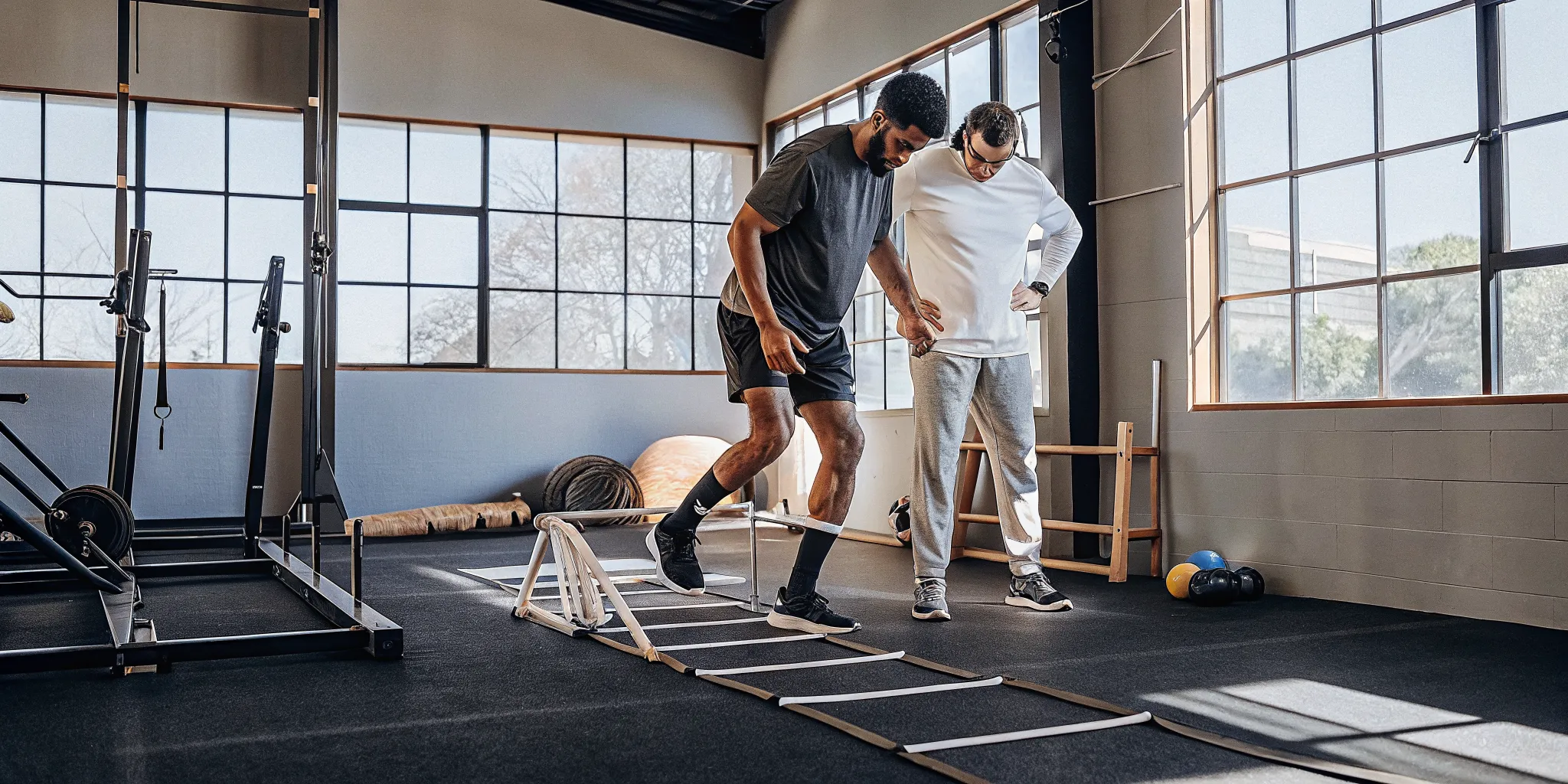
Return-to-sport testing combines performance scores with careful observation of movement quality.
Confidence and gradual return
Physical capacity and psychological readiness affect one another. It is common to hesitate during cutting, landing, or contact after an ACL injury. A therapist can address that concern through graded practice, beginning with predictable drills and progressing toward more realistic situations. Fear should not be dismissed, and confidence should not be confused with physical readiness.
Return to sport is a process, not a single clearance day. It may move from individual drills to noncontact practice, controlled team training, limited competition, and finally unrestricted participation. Work with your surgeon, physical therapist, coach, and athletic trainer when applicable. Physio Logic NYC also offers an integrated sports medicine and rehabilitation approach for patients whose goals involve athletics.
Choosing ACL Rehabilitation Care in Brooklyn
ACL recovery requires months of communication, measurement, and progressive work, so choosing the right clinic matters. Convenience is relevant in New York City, but it should not be the only factor. Look for a physical therapist who can explain the purpose of each phase, tailor the plan to your goals, and show how progress will be measured.
Questions to ask a prospective physical therapist
- How will you coordinate with my surgeon or physician?
- How do you account for graft type, meniscus repair, or other restrictions?
- Which measures will you use to track motion, swelling, strength, and function?
- How do you decide when I can begin running, jumping, cutting, or sport practice?
- What does return-to-sport testing include?
- How will my homework change when symptoms or performance change?
One-on-one attention can be valuable because subtle changes in walking, squatting, or landing are easier to identify when a clinician observes closely. A multidisciplinary setting can also help when the plan requires communication among physical therapists, medical doctors, and other licensed professionals. Each provider should work within their scope and contribute to an individualized care plan.
Making rehabilitation work in NYC life
A strong plan must fit real life. Brooklyn patients may need to manage subway stairs, long walks, small apartments, demanding work schedules, and limited access to a field or gym. Tell your therapist about those constraints early. Homework can often be adapted with appropriate equipment and clear instructions, while clinic sessions focus on testing, technique, and exercises that are difficult to perform safely alone.
Consistency matters, but so does recovery between sessions. Sleep, nutrition, stress, and overall training load can affect how you feel and perform. Your care team can help you set priorities without suggesting that any single habit guarantees a result. To explore local options, visit Physio Logic NYC's page for physical therapy in Brooklyn.
Frequently Asked Questions About ACL Recovery
How long does ACL recovery usually take?
Recovery time varies by injury, treatment, symptoms, activity goals, and progress on objective measures. Return to unrestricted pivoting sport after reconstruction often takes many months and may extend beyond nine months. Your surgeon and physical therapist should guide timing based on healing, strength, movement quality, and readiness rather than the calendar alone.
Can physical therapy help before ACL surgery?
When approved by the treating clinician, prehabilitation may help reduce swelling, restore knee motion, improve quadriceps activation, and prepare you for postoperative rehabilitation. The right plan depends on knee stability, associated injuries, symptoms, and surgical guidance.
What should I do if my knee swells after exercise?
Stop and discuss the response with your physical therapist, especially if swelling is new, worsening, or paired with giving way, locking, significant pain, redness, or fever. Your clinician may adjust load, technique, or recovery strategies. Rest, Ice, Compression, Elevation may be advised for short-term symptom management, but follow individualized medical guidance.
How do I know when I am ready to return to sport?
Readiness should be based on medical clearance, symptoms, motion, objective strength, hop and movement testing, sport-specific performance, and psychological readiness. Passing one test or reaching one date does not guarantee a safe return. A gradual return-to-training process helps the care team observe how the knee responds.
ACL recovery is demanding, but a clear, measurable plan can make each phase more manageable. The goal is not merely to finish therapy. It is to build the capacity, movement skill, and confidence needed for your life while respecting healing and individual differences.
Book an appointment with Physio Logic NYC to discuss individualized ACL rehabilitation in Brooklyn.
This article is for educational purposes only and is not a diagnosis or a substitute for individualized medical care. Consult a qualified healthcare professional for recommendations based on your injury, surgery, symptoms, and goals.